
Ernesto Farfán
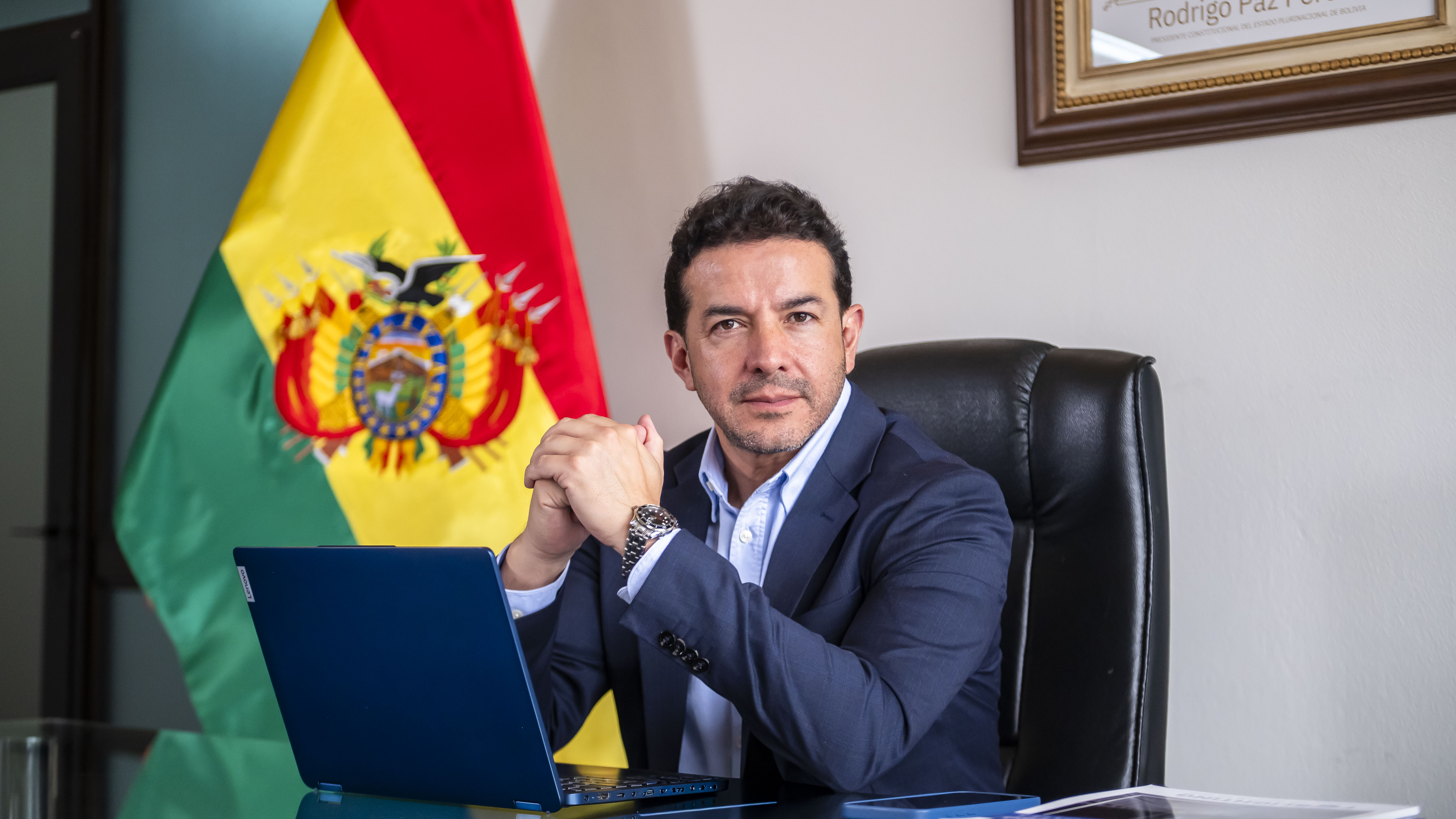
“Credibility is consolidated with results.”
What was the actual diagnosis you made of Bolivia's fundamental road network when you took over the presidency of the ABC? Are we in a moment of road construction, maintenance, or rescue?
Upon assuming the presidency of the Administradora Boliviana de Carreteras (ABC) in November 2025, the diagnosis revealed an institution mired in a deep institutional, operational, and financial crisis. This scenario was characterized by administrative paralysis, opacity in the management of resources, and an alarming absence of reliable information.
Regarding the diagnosis of the Fundamental Road Network (RVF), the state of the infrastructure and the management at the time of the transition, several critical points stand out. For example, the execution capacity plummeted to historic levels, reaching just 44% of total budget execution and 40% in investment during 2025. This resulted in a massive failure to meet physical goals: of the programmed 248.60 km of highway, only 69 km were built, and bridge construction was zero (0%). There is a preservation and maintenance crisis. The condition of the stretches under road conservation is critical, with routes neglected and without maintenance due to vacant bids caused by poorly drafted terms of reference and insufficient budgets. We can affirm that the roads in Bolivia are definitely in an emergency.
What have been the main challenges you have identified in these first months of management?
In the first months of the new administration, critical challenges have been identified stemming from a "Estado Tranca" (Barrier State), such as the very low levels of budget and physical execution, critical deterioration of the Fundamental Road Network (RVF), financial and liquidity crisis; to this is added the collapse of legal and contractual management, negligence in the management of external financing, and zero progress in institutional modernization. In summary, the greatest current challenge is the institutional reconstruction to transform the ABC from a paralyzed entity into an engine of development that recovers the confidence of funders and the public.
What first tangible measures or decisions have you taken since assuming office?
Since I assumed the presidency of the ABC in November 2025, a series of tangible measures and decisions have been implemented to reverse the "Estado Tranca" and rebuild the institutionality of the entity. The main actions reported are:
Implementation of the New Strategic Framework: Management has begun under the Economic and Social Development Plan (PDES) 2026–2030, reorienting institutional planning towards a vision of transparency and efficiency after the closure of the previous cycle.
Information Cleanup and Transparency: As one of the first administrative actions, forcing all managements and units to submit reliable documentation to make the real state of the institution transparent and consolidate the accountability report.
Adoption of Fiscal Discipline: The application of the zero deficit rule has been established in the management of road works, ensuring that each investment responds strictly to criteria of social need and financial sustainability.
Digitalization of the Procurement Process: The implementation of a transparent digital bidding system has been proposed, with the objective of fighting corruption and ensuring that local companies participate on equal terms.
Management of Liabilities and Legal Conflicts: Closing legal liabilities and resolving ongoing judicial processes that kept strategic works paralyzed has been defined as a priority, seeking to recover institutional legal security.
Guarantee of Operational Liquidity: Measures have been taken to guarantee the necessary liquidity for the payment of invoices to contractors and micro-companies of the Provial program, thus avoiding new stoppages due to lack of payment that affect transitability.
Coordination with Funders and Regions: Coordination mechanisms have been deployed with funding organizations and subnational governments to correct pending technical deficiencies and ensure the flow of local counterpart resources.
These measures seek to transform the ABC into a dynamic player in public investment, overcoming administrative paralysis and recovering the trust of citizens and international organizations.
In the management of a highway administration, transparency in the awarding of works is usually a sensitive issue. What control mechanisms have you implemented in your management?
To address the sensitivity surrounding the transparency of public procurement processes and overcome the inherited opacity, we intend to implement control and transparency mechanisms through system integration with the purpose of tackling corruption head-on and ensuring that local companies, especially small and medium-sized ones, can participate on equal terms. This will also make reliable institutional information available to present to the population, social controls, and of course, for the improvement of decision-making.
What is the main bottleneck slowing down the progress of flagship projects, and what concrete solution is the ABC applying?
The main bottleneck slowing down the progress of flagship projects is the phenomenon called "Estado Tranca", an institutional and administrative paralysis characterized by opacity, lack of reliable information, and extreme operational weakness. These measures are part of a comprehensive institutional reconstruction strategy under the new framework of the PDES 2026–2030, aimed at turning road infrastructure into an efficient and transparent engine of development.
Public management is often exposed to constant questioning. How do you build leadership and credibility in a high-pressure environment?
Building leadership and credibility in public management—especially under pressure and constant scrutiny—does not depend on a single action, but on sustained coherence between what is said, decided, and done. Credibility is born of consistency. A public leader must act in accordance with their principles even in difficult situations. People observe complex decisions more than speeches. It is not enough to respond only when there is criticism. Leadership is tested when perfect information is not available.
Making timely, well-founded decisions and assuming their consequences conveys strength, even if not everyone agrees. The creation of technically solid teams, with a high level of commitment and proven moral and ethical integrity, is the foundation of success in public management.
Finally, credibility is consolidated with results. But these must be adequately communicated: translating the technical aspects into citizen language and showing how they impact daily life.
What did the postgraduate program at the UPB contribute to your professional training?
My time at the UPB in the Master's Program in Business Administration and Management allowed me to significantly strengthen my capacity for analysis and decision-making in complex environments. Having technical tools contributes to implementing a more strategic vision of management, better understanding the complexity of institutional environments. In addition, the practical approach and interaction with other professionals enriched my judgment and allowed me to build networks of contacts that help address and solve various management problems.
In public management, where everything is important and urgent, a high degree of sense of prioritization is needed, both in the allocation of resources and of the time and energy that each executive and work team dedicates to important issues. Leadership is also about keeping the team motivated as they face the "Estado Tranca" (structural bureaucracy) that often discourages and frustrates the most qualified officials. Tenacity to achieve objectives is fundamental.
What is the legacy you seek to leave at the helm of the ABC? What highway or change in institutional culture would you like your management to be remembered for?
In institutional and technical terms, I would like our greatest legacy to be the design and launch of the National Road Conservation and Rehabilitation Fund, which must become the main management instrument for the efficient conservation of the road system. Today, one of the biggest problems facing the country is the critical deterioration of road infrastructure, the result of years of neglect and the lack of a management instrument. The Conservation Fund aims to implement a modern, independent, solid, and transparent mechanism to tackle the conservation of more than 18,100 km of highways.
Additionally, we seek to consolidate a road network that integrates territories, reduces gaps, and dynamizes local economies. May each project not be just asphalt, but an opportunity for productive development, access to services, tourism, and territorial cohesion. The most important change I would like to be remembered is having strengthened an institutional culture and having contributed to the reversal of the “Estado Tranca” that does so much damage to our country and its institutions.
How do you define your leadership model in public service?
This new moment in the country generates a massive sense of change. In all spheres of society, there is a feeling that it is time to participate and contribute our best for the reconstruction of the homeland. The values that President Rodrigo Paz Pereira transmits by emphasizing family, country, meritocracy, ethics, and revaluing institutionality are truly motivating and inspiring.
Based on these elements, institutional leadership in the ABC must allow these values to be expressed in each of the actions and efforts developed at all levels, transmitting this new vision to the workforce and generating a strong commitment to it.
