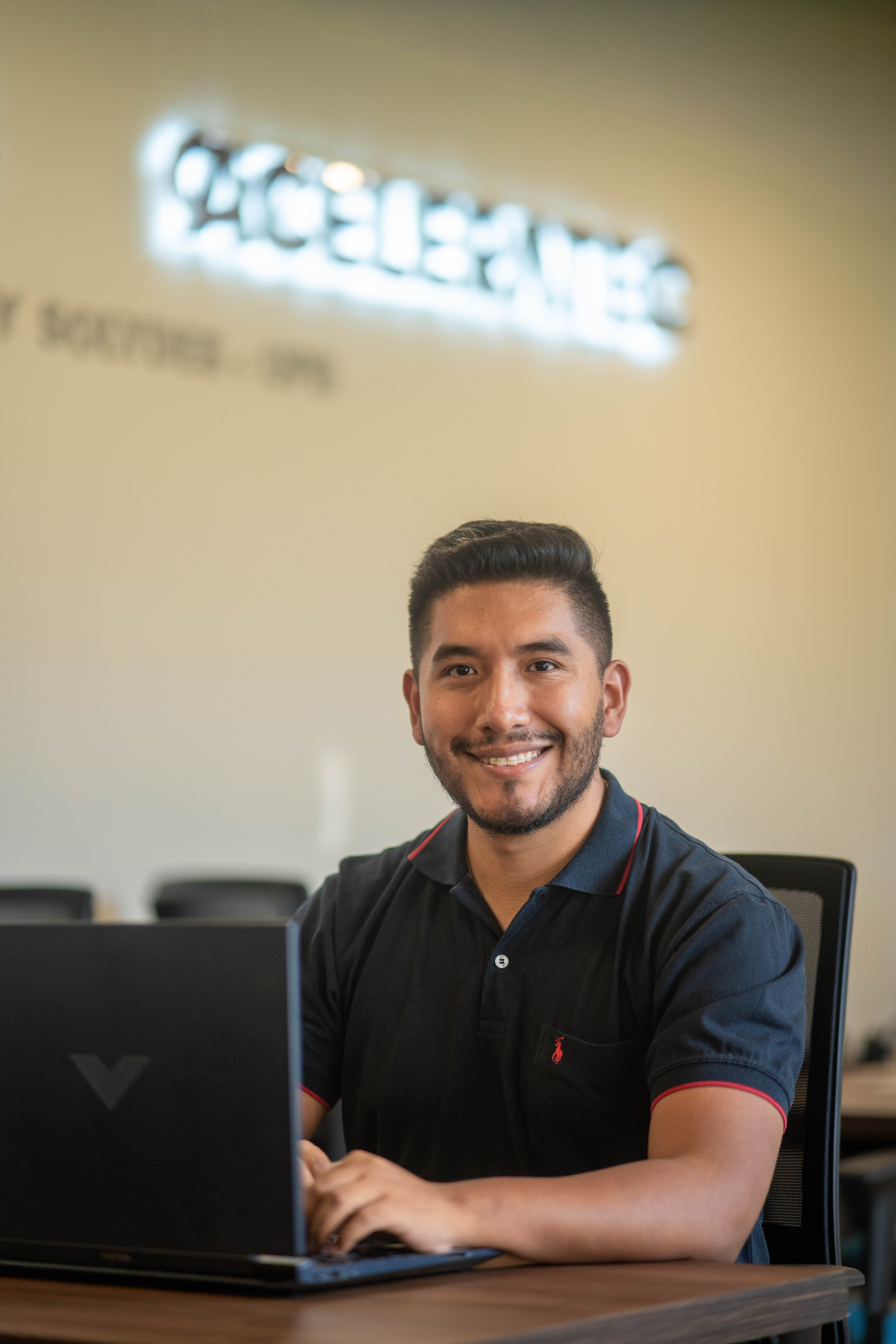
Rodrigo Rodríguez

"There is no time to waste time. Stopping in front of a mistake solves nothing; the important thing is to learn quickly, correct, and keep building"
Your life in startups began before graduating, during your first experience at CityHeroes. What did you discover there that changed your way of imagining a company created from Bolivia?
I discovered the "SAAS" (software as a service) business model and the ability to offer digital services internationally from Cochabamba, Bolivia.
Tu Cuate was born observing a reality that many tech companies didn't look at: the informal economy. What concrete problem did you see and why did you decide to start with the sale of top-ups?
Most of the existing applications for this sector are complex to use and put forward many requirements. We were motivated to start with the resale of top-ups because it is a service that is needed every day nowadays: communicating or being connected to the internet.
In the beginning, Tu Cuate was a much simpler solution than the current platform. What did you learn from the first users and what did you have to change quickly?
We learned that the visual experience must be very simple and striking, to be able to see the most important options at a glance.
At what point did you realize that you were not just building a platform to sell credit, but a tool capable of generating income and opportunities?
From the very first interviews with people who were already dedicated to this but in a traditional way.
You talk about democratizing access to technology. What does that mean in real life for a student, a merchant, a mother, or someone living in a rural area?
It means spreading and promoting the use of applications or platforms without the need to request requirements such as opening a company with a NIT (tax identification number) or large amounts of money to start.

Many of your users have no experience with digital platforms or traditional financial services. How do you build trust with an audience that might still feel distant or fearful of technology?
Two approaches: Product and Marketing. On a product level, the application or platform has to be stable and fulfill its purpose. On a marketing level, generating content on social media where your target audience will look for testimonials from other people and tutorials.
Tu Cuate grew rapidly and went on to process millions of transactions. What was the hardest to scale: the technology, the team, the user trust, or the business model itself?
User trust was the hardest because, being a tool that is not backed by a bank like most mobile wallets, people were susceptible to it being a scam.
What was the most critical moment of the venture, the one where you had to decide between correcting course, persisting, or starting over?
In the third year of service, we stopped growing exponentially and started growing linearly; therefore, it forced us to think about diversification (offering other services for the same community we already had or looking for a new market segment).
In its first year, Tu Cuate was recognized as the Best Startup in Bolivia and later received international projection. What did those recognitions validate and what problems did they not solve?
They validated that the most important thing for a startup is that the idea you have becomes a profitable business model that positively impacts the lives of many people.
You graduated Summa Cum Laude in Industrial and Systems Engineering and then completed an MBA at UPB. What part of that training became an advantage when starting a business and what could you only learn by making mistakes?
The advantage was having acquired the ability to lead and work as a team under pressure; this is thanks to the modular modality of UPB and because you have exams every 8 days. What I learned by making mistakes was choosing the tools to solve problems in the different areas of the company.
You say that undertaking does not mean not making mistakes, but learning and correcting quickly. What mistake significantly changed the direction of Tu Cuate?
The choice of people on the team, over time, we found the right people for each area and they allowed us to delegate functions instead of doing everything alone.
You also maintain that “there is no time to waste time.” How do you differentiate the speed required by a startup from the haste that can lead to a bad decision?
I refer to the fact that we cannot stop in the face of a mistake, a problem, or an idea; a startup has to aspire to fail fast and cheap. Waiting for the perfect moment or for things to sort themselves out over time is not a good idea, you have to take action.